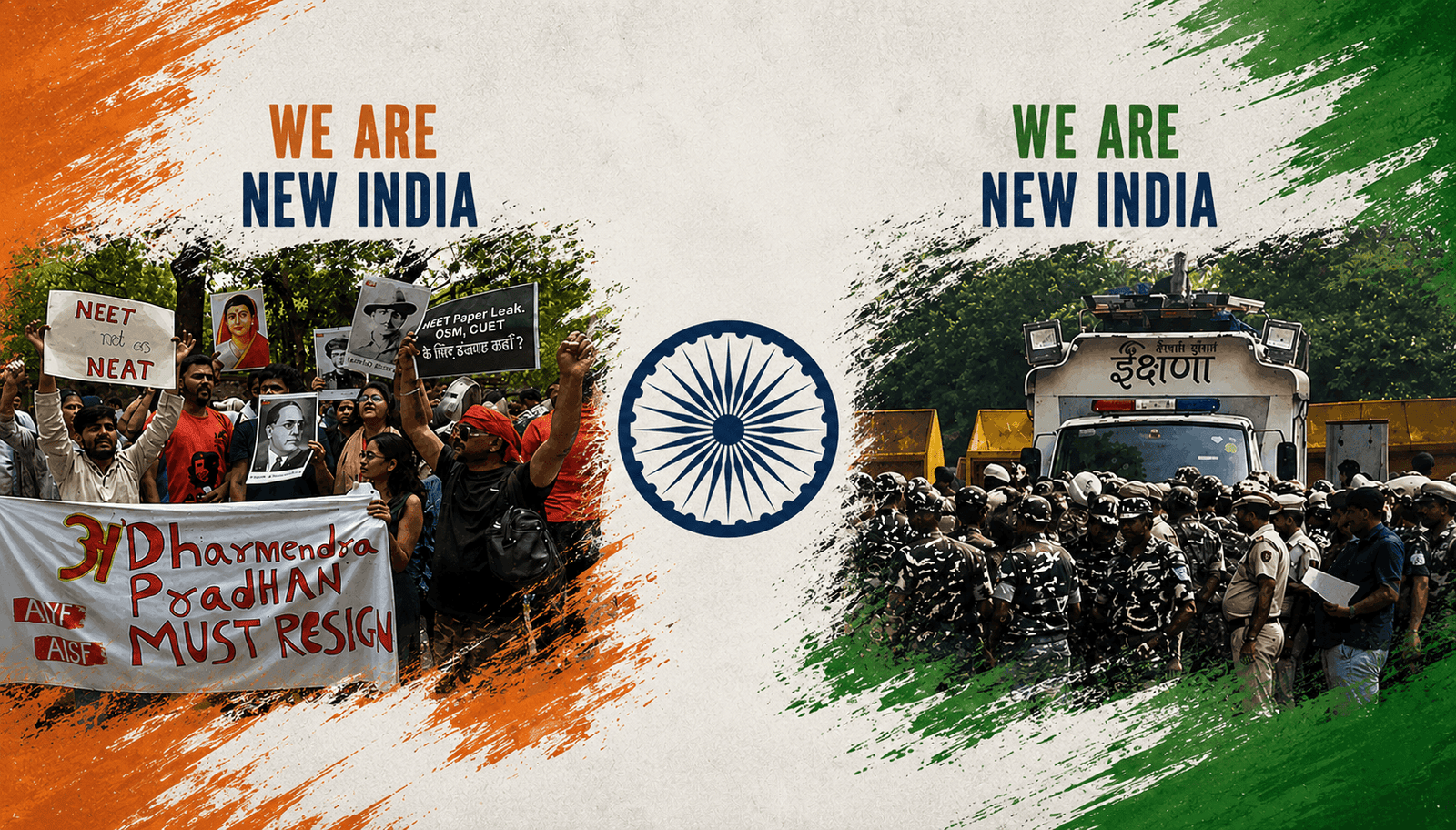
For the last few weeks/months, Indian youth was on the roads ‘peacefully’ protesting that the ruling should take accountability of the recurring examination paper leaks and called for the resignation of the concerned Minister of Education.
The protests took a form as the Cockroach Janata Party (CJP), which was created as a digital campaign to mock the insulting comments by the Chief Justice of India, later gained traction to became the offline youth movement questioning the status quo of the functioning of the government. All happend in less than two months as a series of events. In this opinion piece, I would like to highlight my rationale of key narratives around the protests and the effects.
Is India today divided?
We all know that we are in information war era. So, one who is not right yet more convincing, wins. To understand this, we might have to understand the concepts of philosophy – burden of proof and logical fallacy. I would like to quote two my seniors here as well. One of them said to me years ago that for any positive statement in the world, there is a negative statement and something in between. If the third statement is positive or negative, there will a counter-argument to that as well. The other senior feels that in the information war era, we need a scientific approach to journalism such that we do not have to follow the media houses that just takes sides and broadcast misinformation.
So, we all do not have the same access to the information. We started to believe something that does not question our status quo or our values. Do you think our mothers accept us when we contradict a custom that she believed to be true her entire life?
Politically, India is of course divided. Right or Left. Infact that division is good to maintain the balance. But the problem is that the political polarisation has shifted the frame of reference, the Right are so right that they feel even the center as Left. This is dangerous because this kind of imbalance paves an easy way to spread the narrative we, the rulers, wanted. Any dissent is not seen as disagreement. Why there is a need to hold the national flag when you go out every time to prove that you are also equally nationalist? Are we homogenizing nationalism?
(ChatGPT Explanation) Homogenizing Nationalism : is a form of nationalism that seeks to create a culturally, linguistically, ethnically, or religiously uniform nation. It assumes that a strong nation should have a single, shared identity, and often promotes the assimilation or exclusion of minority groups. The opposite to this is Pluralistic (or civic) nationalism.The power play and deinstitutionalized power
Democracy is the “Government of the people, by the people and for the people” – Abraham Lincoln
If government exists for the people, then public protests become a reminder that democratic legitimacy cannot end with elections. The CJP protests drew a visible line between those governing and those governed. Whether one agrees with the protesters or not, the movement reflected a growing perception that institutions were not responding adequately to public concerns.
This is not the first sectoral protest India has witnessed in recent years. The farmers’ protests demonstrated similar frustrations, although their demands were different. In the case of examination paper leaks, the issue has persisted across several years despite the same party being in power at the Centre for over a decade. Such recurring failures create the impression that accountability has become secondary to political stability. Over time, this weakens public confidence in institutions. Delays in judicial intervention, extensive surveillance of protesters, and increasingly forceful policing further reinforce the perception that institutional power is being used to manage dissent rather than address its underlying causes.
Accountability beyond elections
One of the most striking aspects of the protest was the absence of any visible acceptance of responsibility. Public communication remained limited until the protests expanded across multiple cities, suggesting that political pressure-not administrative accountability-became the primary catalyst for action.
One of my friends argue that demanding a minister’s resignation through public protest establishes an unhealthy precedent. Similar to UK’s change in prime ministerships. I disagree. India’s democratic tradition has always recognised the people’s right to hold those in power accountable. The farmers’ protests did not seek the resignation of the Agriculture Minister, and the CAA protests did not demand the Home Minister to step down. The CJP protests were different because the demand was directed at ministerial responsibility for a specific administrative failure. And the trend might not repeat as well.
I see this less as an attack on democratic institutions and more as a political floor test conducted outside Parliament. If Parliament can question a minister’s confidence within the House, why should citizens be criticised for questioning a minister’s continuance in office outside it? A resignation does not remove an elected representative from Parliament; it merely transfers executive responsibility to someone who may be better positioned to restore public confidence. In fact, there are many examples from the past where ministers accepting moral responsibility for major administrative failures.
No government can eliminate systemic failures overnight. That is neither realistic nor fair. What citizens can reasonably expect, however, is a credible roadmap, transparent communication, and visible accountability. Reform begins with acknowledging failure and explaining how it will be prevented from happening again.
Leave a Reply